
Small Business Audience Research & Market Positioning
YellowLine | Remote | October 2026
THE RESEARCH QUESTION
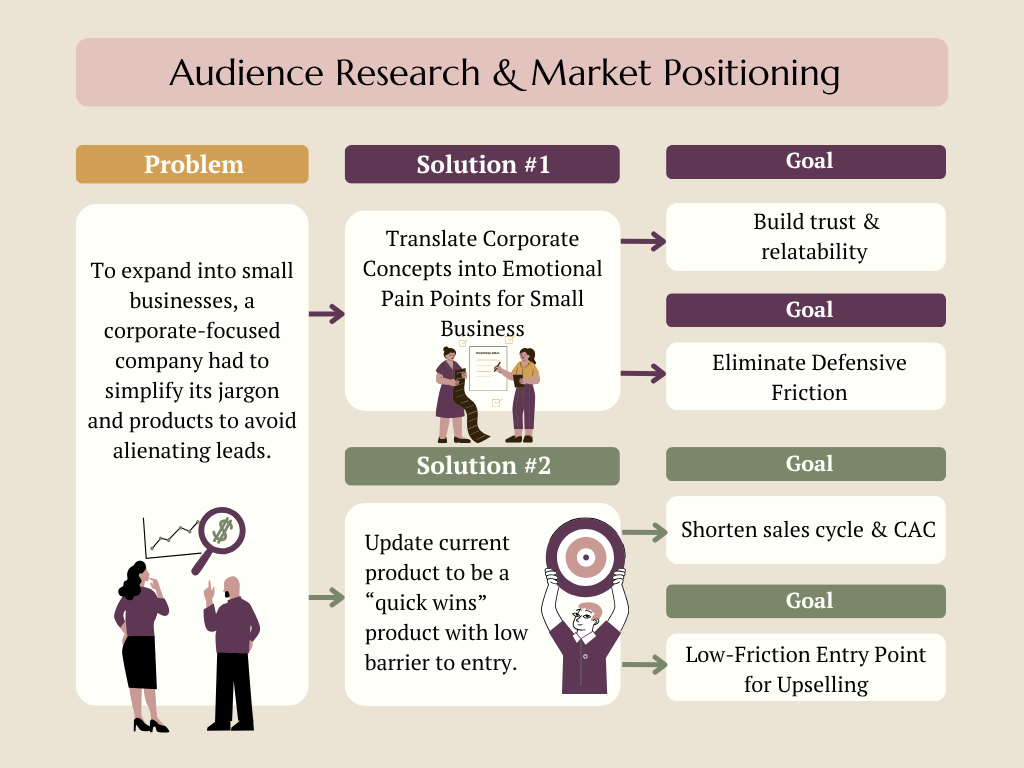
YellowLine had built their business serving corporate clients. When they decided to expand into the small and mid-sized business market, they had a problem: they didn't know who they were actually talking to, what those owners cared about, or whether their existing corporate language would land with a completely different audience. Before building out positioning, pricing, or products for the new department, they needed to understand the people first.
WHO I RESEARCHED & HOW
Designed and administered a general survey distributed across online small business communities and personal networks to gather initial directional data on owner priorities, pain points, and decision-making patterns
Conducted in-depth interviews with small business owners and leaders to go deeper on motivations, frustrations, and the language they naturally used to describe their problems
Recruited participants through a mix of personal contacts and online communities to reach owners across varying business sizes and industries
Coded all survey and interview data in Excel, applying thematic coding to identify patterns across responses before drawing any conclusions
Applied composite persona methodology to protect participant confidentiality while preserving the integrity of the findings
Note on sample size: the research was conducted under budget and time constraints that limited the total number of participants. Findings are directional and the guide explicitly flags that key insights should be validated with a larger sample before major strategic decisions are made.
WHAT I FOUND
Small business owners do not describe their problem as "operational inefficiency" - they describe it as exhaustion, being always on call, and never being able to step away
Corporate language including terms like SOPs, stakeholder alignment, and ROI created distance rather than connection - owners responded to plain language about time back, fewer fires, and not having to do it all themselves
A significant emotional barrier existed around consultants specifically - at least one interviewee described previous consultant engagements as making them feel like they were running their business badly, suggesting that tone and framing were as important as the service itself
Owners frequently misdiagnosed their own problem - most assumed they needed to hire someone or buy software, when the underlying issue was that procedures lived in people's heads and hand-offs were breaking down
Quick wins mattered more than comprehensive solutions - owners were more responsive to the idea of a checklist their team would actually use than a 200-page handbook
WHO I WORKED WITH
Worked directly with the YellowLine founder to align research objectives with the strategic decisions she needed to make around positioning, pricing, and product design for the new small business department.
WHAT I RECOMMENDED
Lead all small business messaging with relief and time back rather than efficiency or ROI - corporate framing would actively undermine trust with this audience
Develop a plain language guide replacing consultant jargon with the words owners actually use to describe their problems
Design entry-level products around quick wins and simple tools rather than comprehensive systems - meet owners where their confidence and budget actually are
Avoid any framing that implies the owner is doing something wrong - lead with what they get back, not what needs fixing
Validate these findings with a larger sample before making major pricing or product investment decisions
WHAT I DELIVERED
A Target Audience Guide including a full empathy map documenting what small business owners say, think, do, and feel - alongside a pain and gain analysis, a plain language guide translating corporate terminology into the language this audience responds to, and a content and tone framework the client could use independently to inform future marketing, product, and sales decisions.
WHAT CHANGED
The client now has a research-grounded foundation for positioning, messaging, and product design for the small business department - including specific language to use and avoid, a clear picture of who the audience is emotionally and practically, and a documented rationale for why the corporate playbook needed to be rebuilt rather than repurposed for this market. They also have a preliminary understanding of pricing for their product that can be adjusted as more data is collected.
"Emily asked questions I’d never thought to ask, helping me clarify my goals and the direction I truly wanted my business to take.” - Amy C. , CEO, YellowLine
WHAT I'D DO DIFFERENTLY
The sample size was the primary limitation of this study. With more time and budget I would have recruited a larger and more systematically diverse participant pool to move from directional findings to statistically defensible patterns. I would also have conducted a second round of interviews after initial synthesis to test whether the empathy map resonated with participants before finalizing it as a deliverable - member checking is a step I'd build into every future engagement of this type.
METHODS & TOOLS USED
Survey design and administration, in-depth phone interviews, thematic coding in Excel, empathy mapping, composite persona development, language and tone analysis, market positioning research